
A Hanukkah Pop-Up Card With a Lit Menorah, and What to Write on It
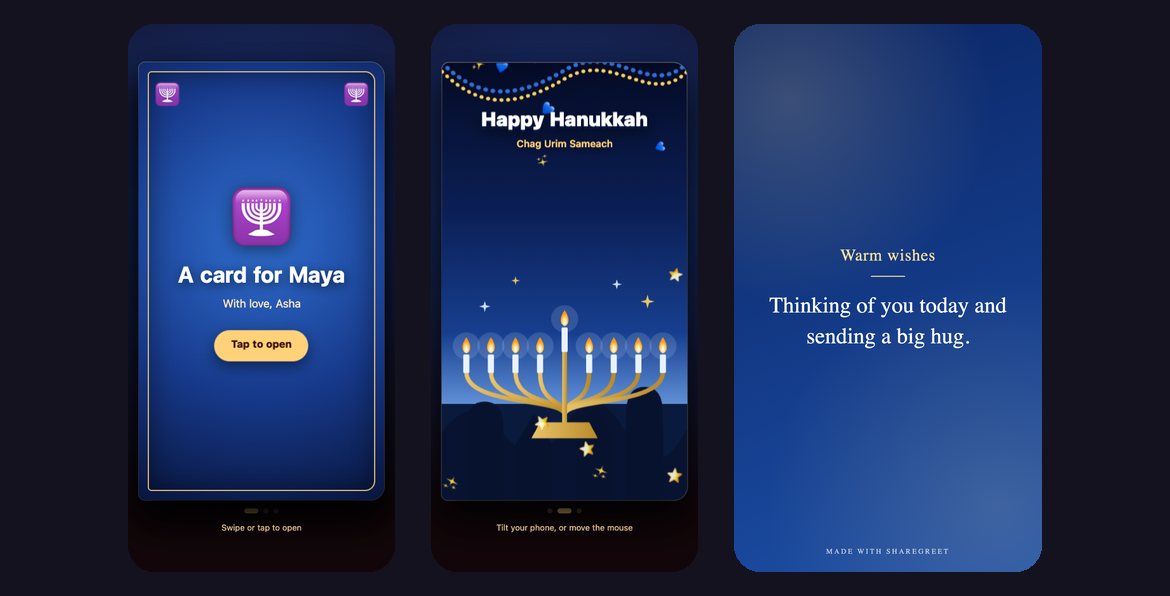
Hanukkah lasts eight nights, so there is room for more than one message. A pop-up card gives you something that feels like a small gift: a closed blue card that opens onto a menorah with all its candles lit, and a few lines from you.
In 2026, Hanukkah begins at sundown on Friday 4 December and the last candle is lit on the evening of 11 December. Check your own community's calendar if you want to be sure of a date.
Example: Maya sends a card to her aunt and to a neighbour
This is an example, not a customer story. Maya is making two cards, one for each, because each should carry the right name.
- Open the Create tab and choose Pop-up card.
- Pick the Hanukkah card. The card opens with the words Happy Hanukkah and Chag Urim Sameach.
- Type the person's name in Who is it for? and yours in From.
- Write the message, or leave it empty to use the card's own line: May the lights of Hanukkah fill your home with warmth, peace and joy.
- Tap Make my card and send the link.
Simple wording
- To family: Happy Hanukkah, Aunt Ruth. I will be thinking of you when I light the candles. Save me a latke.
- To a friend: Wishing you eight nights of light and good company. Chag Urim Sameach!
- To a neighbour who celebrates: Happy Hanukkah to you and your family. Warm wishes for the festival of lights.
- To a coworker: Wishing you a happy Hanukkah and a restful week.
Chag Urim Sameach means "a happy festival of lights". If you are not sure how a person marks the festival, the English line is always safe, and the card's own wording does not assume anything beyond warmth.
Eight nights, eight cards
Some families send a different short message each night. You can make up to 15 cards a day, free, so one card per night to a grandchild abroad is easy. Each card can carry the night in its message: Night three. Three candles lit and thinking of you.
The person who gets the card can answer with an emoji, a voice note or a short video, which makes it an easy way to hear a grandparent's voice. For end-of-year wishes that cover more than one celebration, see Hanukkah and end-of-year wishes.
Frequently asked questions
When does Hanukkah start in 2026?
It begins at sundown on Friday 4 December 2026 and runs for eight nights.
What does Chag Urim Sameach mean?
It means a happy festival of lights. It is the Hebrew greeting on the card.
Is the card free?
Yes. Pop-up cards use no credits.
Can I change the wording?
Yes. Type your own message, or leave it empty to use the card's own line.
Can I send a card for each night?
Yes. You can make up to 15 cards a day for free.